

Assling / Borgholzhausen, November 11, 2025 – One of the hearts of the timber industry in Austria beats in Assling, Tyrol. Since its foundation in 1932, the family-owned company Theurl Austrian Premium Timber has been a specialist in innovative timber construction solutions. Today, in addition to sawn timber and glued laminated timber (GLT), it also produces cross-laminated timber (CLT) from local woods. The fourth generation is ready to lead the company into the future.
In addition to the glued laminated timber plant with a joinery center in Assling, Theurl also operates a sawmill, planing mill, and pellet plant with a CHP (combined heat and power) plant for generating electricity and heat from wood, as well as a CLT plant and joinery center at its newest location in Steinfeld, Carinthia. CLT and cross-laminated timber are used there to produce solid wood panels for wall, ceiling, and roof elements.
"Being able to process a natural raw material using the latest technical possibilities is both contemporary and a privilege," says Hannes Theurl, together with his cousin Stefan Managing Director of Theurl Holding GmbH. "The experience of the generations before us shows us the way." Theurl is now breaking new ground with a compact Satellite® storage system from intralogistics automation specialist Westfalia Technologies GmbH & Co. KG from North Rhine-Westphalia, which went into operation in June 2025. "An automated high-bay warehouse is not a common technology in our industry," emphasizes Hannes Theurl. "But we had been pursuing this for quite some time and were ready for the next step." Change, decisions, generational change—the company consistently pursues its values in technology as well.

Pioneering project for the timber industry
"We believe that automation in warehousing will be a topic of the future in the timber industry," explains Fabian Spitz, Deputy Sales Director Technologies & Systems at Westfalia, who introduced the Austrian timber company to tailor-made storage automation. "And Theurl is certainly playing a pioneering role here, as in many other areas. To our knowledge, the idea of integrating an in-house storage system for unsecured timber stacks into the production process has not yet been implemented on the market."
The in-house high-bay storage system is 12.7-meter-high, 28.5-meter-wide, 108-meter-long, and is equipped with 1,784 storage locations on six levels and a double-mast automated storage and retrieval machine (ASRM) with double Satellite®. It is also unique in that it was commissioned in several phases and – under these circumstances – relatively quickly without any interruption to operations.
"The particular challenge in this project was clearly that we had to implement the entire system during ongoing operations. We worked closely together to keep production disruptions to a minimum," says Fabian Spitz. Westfalia received the order in January 2024, and commissioning began a year later. "We had four construction phases for this commissioning and approved the warehouse for productive use in several steps," explains Simon Zeitvogel, Project Manager at Westfalia. "After construction phase 3 in March 2025, 30% of the warehouse was ready for use, and it was able to go into full operation at the beginning of June."
The precisely timed, step-by-step start-up impressed the Austrian sawn timber specialist, as did the capacity and efficiency of the plant. Hannes Theurl: "I was surprised by this extremely fast commissioning. When we said we would start tomorrow, the deadline was met 100%. Switch on, drive off – it was like getting into a car."
"During the implementation phase, everything was planned and scheduled in great detail," says Fabian Spitz, highlighting the consistent schedule under live conditions. "We test all components in advance at our production facility in Borgholzhausen, which has a large test stand." Only when this quality check has been completed "do we arrive at the construction site, install the components, and then commission the system in a relatively short time."

"The project can be thought of as open-heart surgery," explains Co-Managing Director Theurl. "After all, an uninterrupted production is the be-all and end-all for us. Operations cannot come to a standstill because of a project; everyone has to work together. This only works if both project teams get along well. I believe that the teams from Theurl and Westfalia appreciated each other and worked together on a very professional level. That was essential for the success of the project."
“The concept, technology, and chemistry were right”, says Fabian Spitz, emphasizing the cooperation: "What connected Theurl and Westfalia from the beginning and distinguished them together was the corporate culture, this owner-managed, pragmatic approach, this hands-on mentality. A great customer, a great project."
Project data
Project: Integrated automated in-house storage system for unsecured sawn timber stacks between quality sorting and glued laminated timber production line
Operator: THEURL Premium Austrian Timber
Implementation period: January 2024 to June 2025
General contractor: Westfalia Technologies GmbH & Co. KG


Key project objectives:
- Warehouse management and material flow control via a warehouse execution system with seamless connection to production planning
- Automated in-house storage system for fast storage of unsecured, unpalletized sawn timber stacks and just-in-sequence provision for production.
- Maximum capacity on the same floor space to improve intralogistics and reduce external storage
- Greater operational reliability, lower personnel workload, and reduced staffing requirements in the warehouse
- Sustainable growth at the production site
- Commissioning during ongoing production operations
Groundbreaking technology and warehouse topology
The particular strength of the automated compact storage system lies in its compact, just 12.7-meter-high storage and retrieval machine for loads of up to around 3.7 tons and Westfalia's patented Satellite® technology. The concept was fine-tuned once again for timber processing, explains Fabian Spitz: "The storage process is an integral part of the entire production process. The quality sorting system transfers the unpalletized and unsecured sawn timber stacks to the first of our two transfer cars. This in turn transports the load units to the SRM in the warehouse. The storage system buffers the load units accordingly and passes them on to the processing production at the right time, in the right order, just-in-sequence." Depending on the production order, the product control system instructs the storage system which quality and dimensions are to be provided fully automatically. A second transfer car takes the sorted sawn timber and stores it on the glulam production line.
Such a just-in-sequence concept in warehousing is common in other industries such as automotive, but rare in the wood industry. "We have accommodated as many storage locations as possible in the existing hall and on the available floor space, tailoring the warehouse individually for an optimized process and maximum storage density," explains Fabian Spitz. The 1,784 storage locations for the 1,400 mm to 1,600 mm wide load units are divided into two blocks and 22 multi-deep channels – 3 to 42 storage locations deep. 573 of these storage locations can hold units up to 5,200 mm long. The stacks, which are 114 to 1250 mm high, are divided into three length classes: 3,000 to 3,600 mm, 3,600 to 4,200 mm, and 4,200 to 5,200 mm, and weigh up to an impressive 3,740 kg.
Increased capacity, throughput, and operational reliability
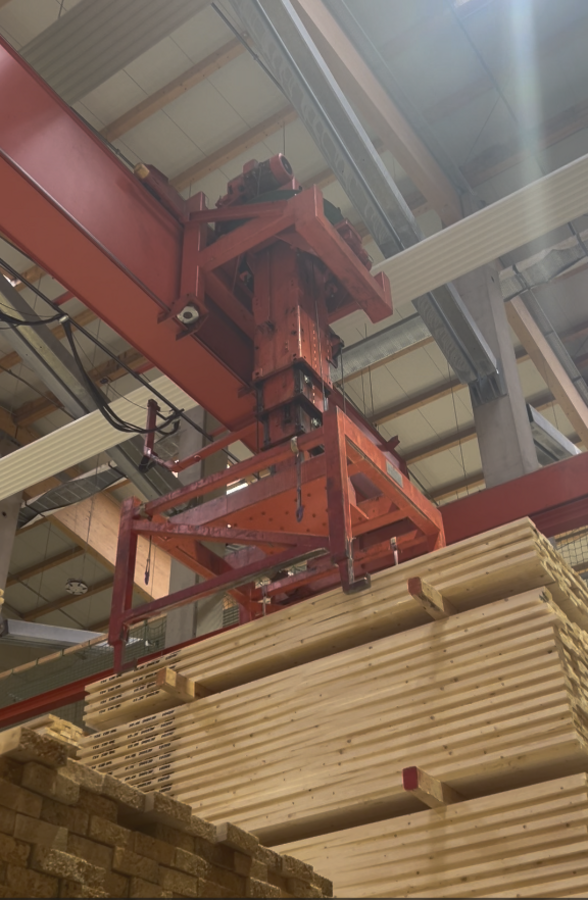
The automated storage system replaces a manual block storage facility. Previously, stacks of timber were stored there in massive towers. "The stacks of wood were stacked on top of each other from the floor to the ceiling using an indoor crane," says Westfalia Project Manager Simon Zeitvogel, describing the previous situation. "This overhead crane had to be operated by employees in three shifts – and with the utmost care to ensure safety. The employees can now be deployed elsewhere, and the risk of stacks being damaged or falling over if an employee operates the overhead crane incorrectly is now eliminated."
The robust storage and conveyor technology ensures particularly high availability and dynamics. The higher storage density has more than doubled the capacity for quality-sorted raw lamellas. "This optimizes production planning and allows us to store less raw material outdoors," explains Hannes Theurl. "For us, this is another milestone."
Simon Zeitvogel: "The SRM stores longitudinally and at high density with 18 double cycles per hour, in and out. The transfer car between quality sorting and the high-bay storage system transports 18 load units per hour, while the transfer car between the warehouse and the glued laminated timber line handles 15 load units per hour. We have also implemented three chain conveyors for picking up and delivering to and from the factory yard." The rejects from the quality sorting process can be removed via the SRM: To do this, the Satellite® drives the load unit into one of the chain conveyor lines and deposits it there. "In special cases, there is also the option of bringing loads into the system by forklift via one of the chain conveyors at the factory yard intake." Theurl has shortened and raised the inventory conveyor technology flanking the warehouse, thus seamlessly connecting it to the new Westfalia conveyor technology.

Safe and fast transport movements
The advantages of the Satellite® load handling device are central to the concept. It enables highly compact, multi-deep storage as well as fast and accurate transport movements for heavy loads and bulky formats. Together with the multiple support of load units, these protect the material and reduce wear and tear on the system. This is because the load handling devices and the additional rail profiles in the rack compartments support the load units at additional points, preventing bending, tilting, and damage to pallets and stacks of wood. This also prevents system malfunctions. Gentle acceleration and deceleration ensure that the unsecured wooden slats on the stack do not slip.
Other technical requirements for automation include precise sensors and actuators, which enable the safe transport and sequencing of heavy stacks, control technology, and the Savanna.NET® Warehouse Execution System (WES) – the digital control center where material flow control and warehouse management converge. Development, implementation, and key components come from a single source—the Westfalia Group, which combines machine and plant engineering with software development, control programming, and control engineering under one roof.
Project results
- Process reliability minimizes the risk of material damage and accidents
- Complete warehouse transparency and more than double the storage capacity for unsecured, unpalletized sawn timber stacks between quality sorting and the glued laminated timber production line
- External storage of raw slats is significantly reduced
- Fast automated storage processes thanks to multi-deep, single-aisle Satellite® storage system with double Satellite® , 1784 rack positions and conveyor technology for connection to quality sorting and JIS provision for glued laminated timber production
- Option to increase production through higher throughput and greater capacity in the warehouse
- Reduction in workload for personnel


Savanna.NET®: Control center for automation
Savanna® creates a virtual twin of the warehouse, all implemented load units, and possible storage variants. The algorithms provide storage strategies for multidimensional shelf management. The various length classes and quality characteristics are optimally combined in the storage channels according to the data transferred – i.e., the order entries fed in from the production control system – and, if necessary, relocated depending on channel occupancy. This ensures that sawn timber units are always in the correct sequence and directly accessible for removal from storage. The WES determines the most logistically efficient and energy-efficient variants and instructs the necessary transport movements. The WES completely controls the SRM as well as upstream and downstream conveyor technology – transfer cars and chain conveyors.
In the central control room for monitoring production processes, Savanna® provides all information in a clear manner in response to dynamic queries, providing information on article and pallet details, the fill level of the storage channels, and the movements of all load units. Logs from the exchange with the production planning system, the system status, possible faulty load units, and interruption times can also be retrieved. Load units that do not pass the contour check are automatically removed from storage to avoid disruptions. Information can be accessed quickly and clearly via the context menu, and warehouse management and control are intuitive to use. The production and warehouse team can speed up workflows in intralogistics and make optimal use of storage space. Individual orders can be implemented directly in the software.
Increased efficiency and safety of all processes
After the first few months of live operation, intralogistics automation is already reflected in the figures, explains Hannes Theurl: "We can store more than twice the volume of sawn timber in the warehouse space and sort it efficiently. With a permanent staff, we can significantly increase production in terms of inventory, relieve the burden on personnel, and at the same time increase process reliability and operational safety."
"I think that with this professional handling and close cooperation, we are on the same wavelength," says Managing Director Theurl, drawing a positive conclusion. "This technology is definitely the future for us. I assume that this high-bay warehouse will not remain the only one in our group of companies – and Westfalia is of course our first point of contact."

