
Borgholzhausen, October 10, 2025 – Warehouse automation with shuttles or storage and retrieval machines (SRM)? Classic shuttle systems are experiencing a boom in the wake of e-commerce and high-throughput automated small parts warehouses. However, which system pays off depends heavily on the type of goods or load units, the weight of the load units, the actual throughput required, and individual processes, storage strategies, and objectives.
The decision to implement an automated storage system is a strategic one that will have a long-term impact on the efficiency, capacity, and operating costs of a company and its intralogistics. We highlight the key strengths of each system in a direct comparison.
What is a classic shuttle system?
A shuttle system uses self-driving vehicles (shuttles) to store and retrieve goods from a rack. These flat transport vehicles move horizontally on rails in rack channels. They are usually level-bound. This means that shuttles are responsible for a specific rack level, where they pick up pallets and containers or transport them to their rack position.
Often, a large number of these vehicles are used to perform many transport movements simultaneously in parallel. Since they operate autonomously, they can serve storage channels of any depth horizontally. In some systems, the shuttles are stored in vertical shafts instead, while they travel on a single level above or below the rack matrix.
In level-bound shuttle systems, several vertical conveyors ensure the vertical transport of the load units between the levels. The system therefore implements horizontal and vertical transport separately. Multi-level shuttle systems, on the other hand, use shuttles on several levels. Not only goods but also shuttles are moved between the levels.

What distinguishes classic SRM systems?
Most storage and retrieval machines (SRMs) are operated with telescopic forks as load handling devices and are used to serve single-location and double-depth storage areas. A maximum of two load units are stored behind each other in such storage compartments. In contrast to shuttles, SRMs handle both horizontal and vertical storage movements, and in some designs also multiple storage aisles. As with shuttle systems, there are also special designs here—such as the Satellite® storage system from Westfalia Technologies, which is classified as both a SRM system and a multi-level shuttle system.
Satellite® storage systems are named after their load handling device. The SRMs are equipped with a Satellite®. This flat shuttle is a channel vehicle that operates on all shelf levels and in all shelf compartments or storage channels of a storage aisle. It detaches from the SRM, drives into multi-deep storage channels that hold many load units close together in a row, and stores, transfers, and retrieves them there.
Load limits and throughput
Shuttle systems are optimized for light to medium loads of up to 1.5 tons per load unit. Due to the high number of individual vehicles and the correspondingly high number of parallel transport movements, they can achieve a particularly high throughput for these "weight classes."
Since several shuttles can operate in parallel on different levels, storage and retrieval can be carried out simultaneously. Performance is increased by adding additional shuttles. Shuttle systems are generally ideal for the distribution of smaller, lighter load units.
SRM systems are the choice for heavy to very heavy loads up to 7.5 tons, and even more in special designs. This makes them the only option for storing heavy bulk goods and bundling goods into large load units. In Satellite® warehouses, the multiple support of loading aids by additional rail profiles ensures safe warehouse movements and less material damage. Warehouse logistics are concentrated on as few warehouse vehicles and warehouse locations as possible, with corresponding cost advantages.
The access frequency in SRM systems is defined by the speed of the individual SRM. SRM systems increase their throughput by using several SRMs per aisle and load handling devices for transporting several load units. This allows multiple Satellites in Westfalia systems to accommodate several load units simultaneously and large-format load units.

Height limits and space utilization
Shuttle systems typically reach heights of 15 to 30 meters. At very high warehouses, the loads would place extremely high demands on the static structure of the rack and the lifting mechanisms of the vertical conveyors. Construction would be complex and expensive. The system is optimized more for horizontal movements – many fast and parallel warehouse movements.
The access frequency of shuttle systems can be quickly increased by the number of shuttles used. Shuttle systems can be adapted to unconventional hall and rack structures thanks to their high modularity and flexibility. Due to the necessary intermediate platforms in the rack aisle, shuttle systems require a higher structure and thus achieve fewer storage levels at a given system height.
SRM systems achieve maximum space utilization in the vertical direction. They are ideal for high-bay warehouses from 6 to 45 meters – in some cases even more – with maximum capacity on a consistent floor space. SRMs are designed with one or two masts for vertical and horizontal movement even at great heights, with the necessary stability and load capacity – but also with the corresponding dead weight.
Compact storage systems with Satellite® in particular require very few vehicles. Two multi-deep storage blocks can be operated entirely from a single aisle. This creates additional storage space. SRM storage systems are therefore also suitable for limited and narrow floor space. The particularly high degree of space utilization is particularly suitable for medium throughput and a low to medium range of products.
In multi-deep storage channels, not all items are always directly accessible. Storage strategies and storage topology must be well coordinated. Variable center blocks, which can be operated from two sides and can be divided as required for different item structures, increase flexibility in inventory management.

Operating costs
Shuttle systems are usually more energy-efficient per storage and retrieval cycle. The reason for this is their lightweight construction and the separation of horizontal and vertical movement. A shuttle moves horizontally with a relatively low mass, while a separate, energy-optimized lift takes care of the energy-intensive vertical movement. However, a potential disadvantage of shuttles is the cumulative standby consumption of the many individual units.
With each lifting operation, a SRM must move its entire massive structure, which combines horizontal and vertical movement. However, it is capable of lifting loads over 1.5 tons without exception. Modern drives, storage systems, and the bundling of transports reduce the gap in energy consumption compared to shuttle systems.
Modern drives in SRM systems transfer excess energy from horizontal and vertical movements to the other axis. In both SRM and shuttle systems, braking energy is recovered, stored, and made available for transport movements.
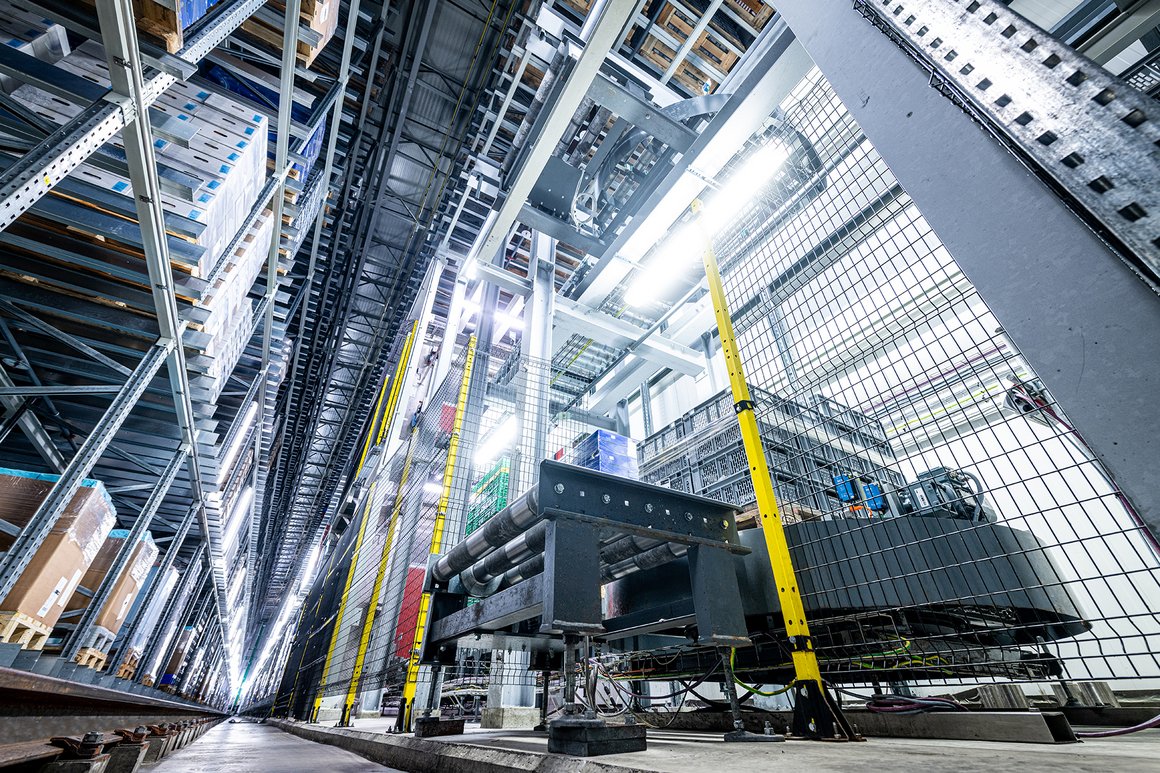
Thanks to their simpler, more robust design and the small number of components, SRM systems generally have lower maintenance costs. One SRM per aisle means that there is only one device that needs to be maintained. With shuttle systems, every single shuttle, every lift, and the associated infrastructure must be maintained. This makes maintenance more complex and expensive.
In a direct comparison, the control and coordination of many individual vehicles and simultaneous warehouse movements is also more complex and error-prone in terms of software and control than the control of fewer individual vehicles – with correspondingly higher maintenance costs.

Acquisition costs
Traditionally, SRM systems are often cheaper to purchase per rack position, especially in large, automated high-bay warehouses. The technology has been established for decades. This has led to standardized and efficient manufacturing processes. The main component per aisle is a solid but singular device.
Shuttle systems often require higher initial investments per storage location. This is due to the large number of active components required: several shuttles per aisle and separate vertical lifts for transport between levels must be purchased. The complex control system and the infrastructure for supplying power to the shuttles also drive up costs.
Fail-safe capability
The decentralized structure of shuttle systems results in a high level of reliability. If a single shuttle fails, the other shuttles can take over its tasks, and operations are hardly interrupted. Shuttles are replaced during operation. This high degree of redundancy is invaluable, especially in high-throughput environments such as e-commerce logistics.
At first glance, SRM systems appear to be more vulnerable because the failure of a single SRM can potentially paralyze an entire storage aisle. However, modern SRM systems use variable center blocks without a fixed center line, allowing a storage block to be fully served by the two flanking storage aisles. In addition, large systems have multiple SRMs operating in one aisle, ensuring high reliability and redundancy, even during maintenance. If one device fails, the other can take over. On the software side, alternative transport routes provide the necessary redundancy. Consistent system monitoring ensures additional system availability.
Conclusion: A question of priority
Both shuttle and SRM systems have proven themselves in modern, automated warehouse logistics.
- Shuttle systems are particularly well suited for very high throughput because they enable high scalability and parallelization of warehouse movements. The maximum throughput should amortize the often higher acquisition and maintenance costs.
- SRM systems can be the more economical solution for medium to high throughput because they are often more robust and require less maintenance. Acquisition and maintenance costs per storage location are generally lower.
- Shuttle systems are suitable for storage heights of up to approx. 30 meters, with high modularity and scalability. They are designed for particularly high storage throughput – for loads of up to 1.5 tons. This makes them indispensable in modern retail and small parts storage.
- In terms of the ratio of floor space to storage capacity and access heights of 45 meters and more, SRM systems have more room for improvement and are suitable for maximizing capacity on a minimum floor space. They focus on the bundling of logistics. Particularly compact SRM in lightweight construction and the slim base make them interesting for existing properties and narrow floor plans.
- Shuttle systems are more energy-efficient when handling light to medium loads. SRM systems save energy by having fewer vehicles on standby and enabling multiple transports. For loads over 1.5 tons, bulky loading units, and unusual formats, they are often the only option.

- When it comes to reliability, shuttle systems rely on a large number of vehicles for maximum redundancy. SRM systems are based on several SRMs per aisle, variable center blocks, and durable technologies.
The right and most economical system choice in the long term therefore requires good analysis, consultation, and planning. Which system should be used and when is a question of priority and individual company processes.

